|
ACCREDITATION |
|
|
Peer Review Process
Peer Review Process
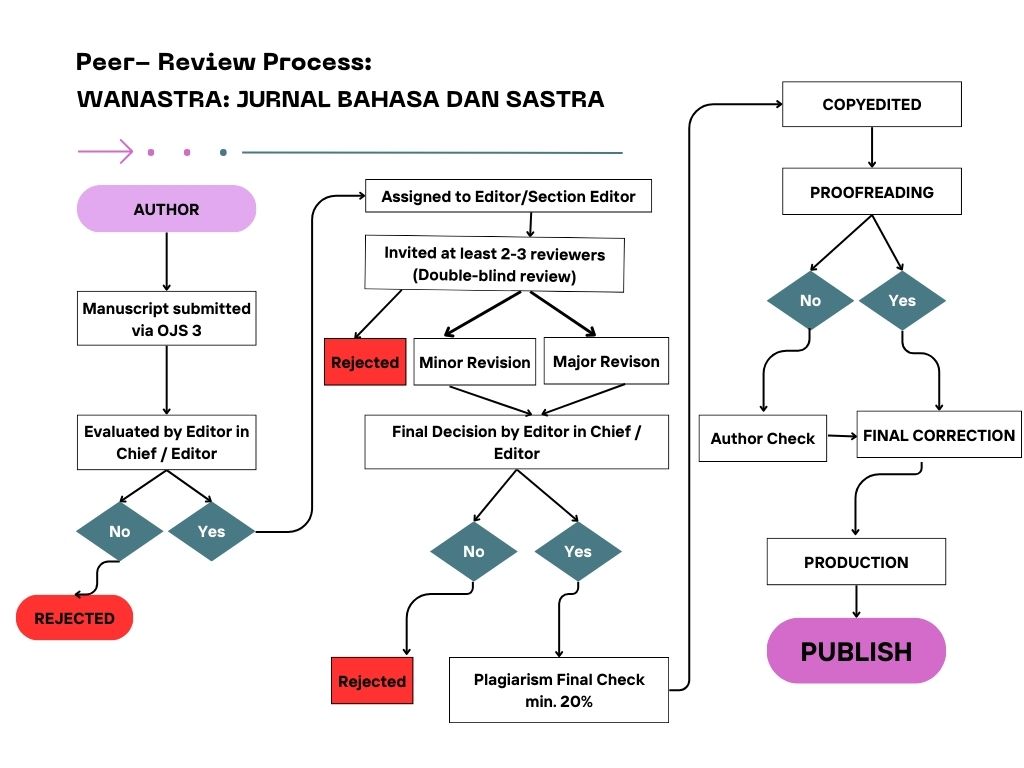
All submissions to Wanastra: Jurnal Bahasa dan Sastra undergo a rigorous peer-review process to ensure the academic quality, originality, and relevance of the published works. The journal uses a double-blind peer-review system in which both authors and reviewers remain anonymous throughout the evaluation process. Each manuscript is assessed by experts in the relevant field to maintain high scholarly standards and uphold ethical publication practices.
1. Initial Evaluation
The Editor-in-Chief or the assigned Editor conducts an initial screening to determine whether the manuscript fits the journal’s aims, scope, and formatting requirements. Manuscripts that fail to meet these criteria will be rejected at this stage. A plagiarism check is also conducted, and manuscripts with a similarity score exceeding 20% will be rejected. If formatting or structural issues are identified, the manuscript may be returned to the author for correction and resubmission. Manuscripts that pass this stage proceed to the review process.
2. Assignment of Reviewers
The Editor or Section Editor selects at least two to three qualified reviewers with relevant expertise. To maintain objectivity, the identities of both authors and reviewers are concealed. Submitted manuscripts must remove any information revealing the author’s identity, acknowledgments, or direct references to author contributions. Invitations are then sent to selected reviewers, who are chosen based on expertise, absence of conflicts of interest, institutional diversity, and willingness to participate. The journal aims to assign reviewers within one week of the initial evaluation.
3. Review Process
Reviewers assess the manuscript based on the following criteria: introduction, methods, results, discussion, and conclusion. Reviewers typically have one week to complete their evaluation. They may recommend acceptance, minor revision, major revision, or rejection. Constructive comments are provided to assist authors in improving the quality of their manuscripts.
4. Editorial Decision
The final decision is made by the Editor-in-Chief or the assigned Editor after reviewing the reviewer reports. If reviewer recommendations differ significantly, the Editor may invite an additional reviewer for further assessment. Decisions are communicated through the online system. As part of the journal’s double-blind policy, reviewer comments remain anonymous. The estimated time from submission to the initial decision is approximately two weeks.
5. Revision Process
If revisions are required, authors must address all reviewer comments and submit a revised manuscript with highlighted changes, along with a response or rebuttal letter explaining how each comment was addressed. The revision timeline is typically one week for minor revisions and two weeks for major revisions. Manuscripts requiring major revisions undergo a second round of review by different reviewers, while minor revisions may be evaluated solely by the editorial team.
6. Copyediting, Proofreading, and Publication
Accepted manuscripts proceed to the copyediting phase, followed by proofreading. Authors may be asked to confirm or correct minor details during this stage. After final corrections, the manuscript enters production and is prepared for publication. Only manuscripts that meet all academic, ethical, and formatting standards will be published in Wanastra: Jurnal Bahasa dan Sastra.